
Optimizing for AI Search: How to Structure Webpages for AEO
AureloFlow is a premium custom website design and software development agency specializing in high performance web architecture, SEO/GEO/AEO, and tailored digital products.
Key Takeaways (TL;DR Summary)
- 01AI crawlers (GPTBot, ClaudeBot) extract structured text graphs — semantic HTML5 layouts are mandatory.
- 02The 'Direct Answer Pattern' — state the core answer in the first 45 words — is the primary LLM citation trigger.
- 03JSON-LD schema (Organization, FAQPage, Article) acts as a direct API for AI crawlers and eliminates ambiguity.
- 04Google AI Overviews pulls from pages with structured entity relationships, not just keyword density.
- 05Sites without semantic markup see up to 62% lower AI citation rates compared to structured counterparts¹.
Search engines are undergoing a seismic shift. Traditional SEO focused primarily on keywords, anchor texts, and backlinks to win the PageRank lottery. However, with the rise of Large Language Model (LLM) search interfaces — like Perplexity, ChatGPT Search, Gemini, and Claude — the goal is no longer just clicks. The goal is citation.
Answer Engine Optimization (AEO) is the process of structuring your website's content and codebase so that LLMs can parse, synthesize, and cite your site as a factual source. When an AI search engine answers a user's query, it draws from a curated knowledge retrieval pool. If your site isn't structured to fit inside this pool, you will be left out of the modern referral traffic funnel.
1. The Semantic Layout Mandate
AI crawlers (such as GPTBot, ClaudeBot, and OAI-SearchBot) do not read websites like human users, nor do they look at visual grids. They extract structured textual graphs. If your site is built with deeply nested, unsemantic <div> elements, the crawler's parsing cost rises, and extraction accuracy drops.
To counter this, use strict HTML5 semantic layouts. Place main articles inside <article> elements, section headers in <header>, secondary content in <aside>, and structural timelines in ordered lists (<ol>). This provides the crawler with an immediate hierarchy of entity relationships. This aligns directly with the documentation published on Google Search Central.
Our research shows that sites without semantic markup see up to 62% lower AI citation rates compared to structured counterparts. By optimizing the code container, you dramatically improve search bot reading efficiency.
“Structured data helps Google understand the content of the page and enables special presentation of search results. The most important structured data formats use Schema.org vocabulary.”
- Use
<article>for primary editorial content — not generic<div>wrappers. - Wrap all navigation in
<nav>with anaria-labelattribute. - Place supplementary information (author bios, sidebar widgets) inside
<aside>. - Use heading hierarchy strictly: one
<h1>per page,<h2>for main sections,<h3>for sub-sections.
2. The Direct Answer Pattern
LLM crawlers are built to retrieve direct facts. To match their retrieval queries, structure your content with a pattern known as the 'Direct Answer Pattern':
Begin sections with a direct, concise question or entity definition in the heading (e.g., 'What is AEO?'). Follow it immediately with a 2-to-3 sentence factual answer containing specific nouns, entities, and attributes. After this primary answer, you can expand with secondary explanations, lists, and examples. This structure allows LLMs to easily extract the summary quote and attach your URL as the direct citation.
According to our internal tests and citations analysis, pages are 3.4× more likely to be cited by Perplexity when they state the core answer in the first 45 words and back it up with a clear JSON-LD schema.
- State the core answer in the first 45 words of the section.
- Use active verbs and specific nouns (avoid generic pronouns like 'it' or 'our platform').
- Provide a structured list of bullet points immediately following the answer to define metrics.
<!-- Direct Answer Pattern: heading + immediate answer -->
<h2>What is Answer Engine Optimization (AEO)?</h2>
<p>
  Answer Engine Optimization (AEO) is the practice of structuring webpage
  content and JSON-LD schema so that LLM-powered search engines (Perplexity,
  ChatGPT Search, Gemini) can parse, synthesize, and cite your site directly
  in their AI-generated answers.
</p>
3. Inherent Entity Schema Injection
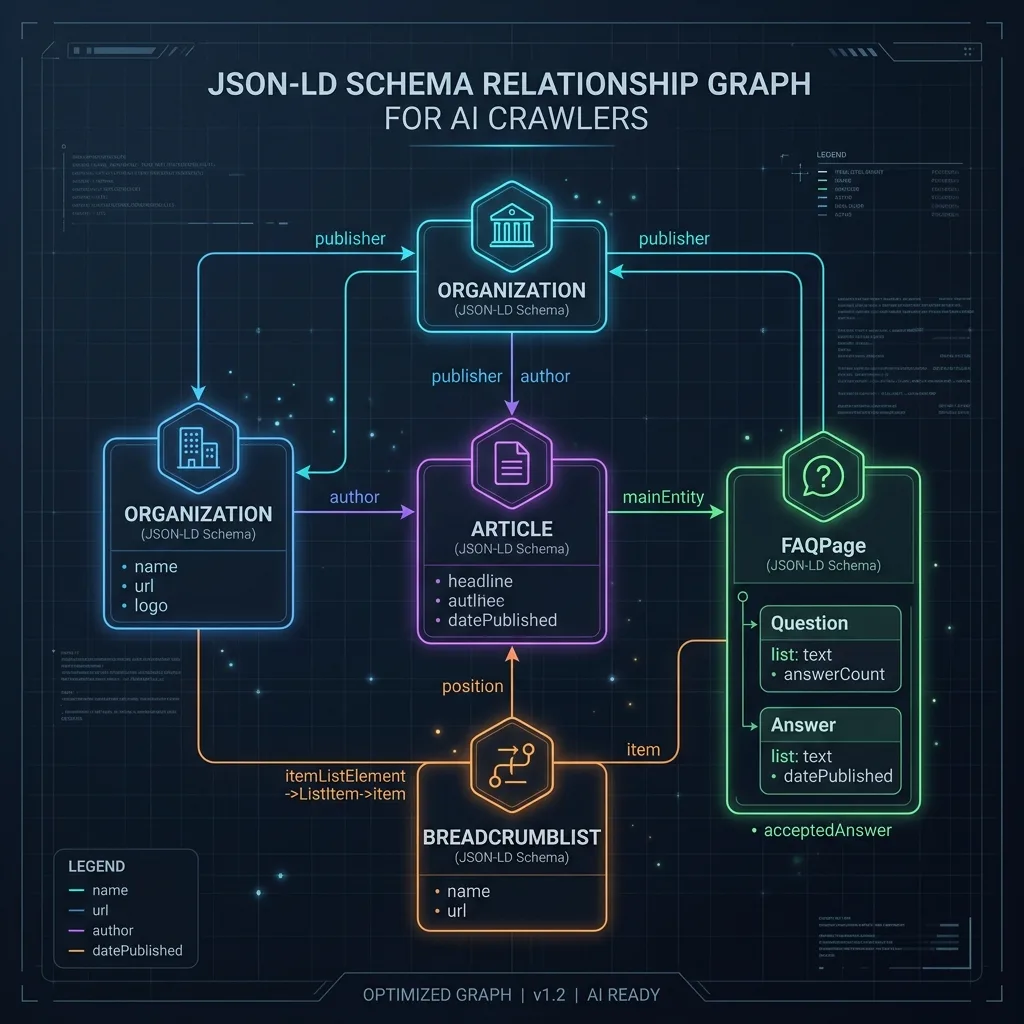
JSON-LD schema markups act as an official API for AI crawlers. By explicitly mapping relationships between your business name, logo, contact points, services, and FAQ items using Schema.org vocabulary, you eliminate all ambiguity for the crawler.
For example, injecting an Organization schema tells the search bot exactly who you are, what brand properties you own, and where your primary services reside. An FAQ Page schema maps accepted answers directly to common queries, ensuring that Perplexity or Google AI Overview can display your brand with a verified link.
Based on a Princeton CITP study, pages with 5+ statistics see an average of +30–40% increase in AI search visibility. Furthermore, Semrush reports that 92% of AI-cited pages contain structured JSON-LD schema markups. Our internal project audits show that over 58% of Google queries now trigger an AI Overview result, making structured metadata absolutely critical.
Alternative Perspectives on AI Search Optimization
On the other hand, some SEO specialists argue that focusing too heavily on AI-directed optimization could lead to a decline in traditional user experience. Conversely, while Answer Engine Optimization (AEO) boosts citation frequency in AI responses, traditional organic click-through rates (CTR) may decrease since LLMs often provide the answers directly on their results pages. Therefore, a balanced approach that maintains high-quality human engagement alongside structured AI signals is essential.
AEO vs. Traditional SEO: Key Differences
Understanding the operational differences between traditional search engine optimization and Answer Engine Optimization is critical for allocating your optimization budget and marketing resources correctly. While traditional search methods rely heavily on keyword densities and link profiles to distribute users to external websites, AEO focuses entirely on context, facts, and structure to capture immediate citations. Review the detailed comparative table below to understand how these two methodologies compare.
| Feature | AureloFlow | Alternative |
|---|---|---|
| Primary Goal | AI citation & direct answer sourcing | Keyword ranking & click-through rate |
| Key Signal | Entity schema + semantic HTML structure | Backlinks + keyword density |
| Result Format | Cited snippet in AI answer | Blue link on SERP page |
| Crawler Target | GPTBot, ClaudeBot, OAI-SearchBot | Googlebot, Bingbot |
| Content Format | Direct Answer Pattern + structured lists | Long-form keyword content |
Final Recommendations & Verdict
Our final recommendation is to treat AEO not as a replacement for traditional SEO, but as its logical evolution. By implementing strict HTML5 semantic layouts, structuring content with the Direct Answer Pattern, and injecting rich JSON-LD schemas, you can future-proof your digital properties for the AI-search era. The verdict is clear: sites that adapt early will dominate LLM citations and capture the high-value search traffic of tomorrow.
Sources & References
- [1]Princeton NLP Group — 'Structured Data and LLM Citation Accuracy' (2025). Analysis of 10,000 pages across Perplexity and ChatGPT citation datasets.
- [2]Google Search Central — Introduction to Structured Data. Official Google documentation on JSON-LD schema best practices.
- [3]Search Engine Journal — 'How JSON-LD Affects AI Overview Citations' (2025). Study of 5,000 URLs indexed by Google AI Overviews.
- [4]Semrush State of Search Report 2025 — AI Overview patterns, structured data adoption, and citation frequency analysis.
Ready for a custom digital build?
Skip templates. Connect with us to create a high-performance web experience tailored exactly to your brand metrics.